
One Battle After Another Movie Review: A Frenzied Portrait of Resistance, Rupture, and Relentless Survival

A Movie Review by Marc Primo
One Battle After Another is not interested in comfort, clarity, or consensus. It charges forward like a runaway thought, messy, loud, and impossible to fully contain. What emerges is a volatile mix of political paranoia, dark comedy, and bruised humanity, stitched together into an experience that feels less like a traditional narrative and more like a living argument.
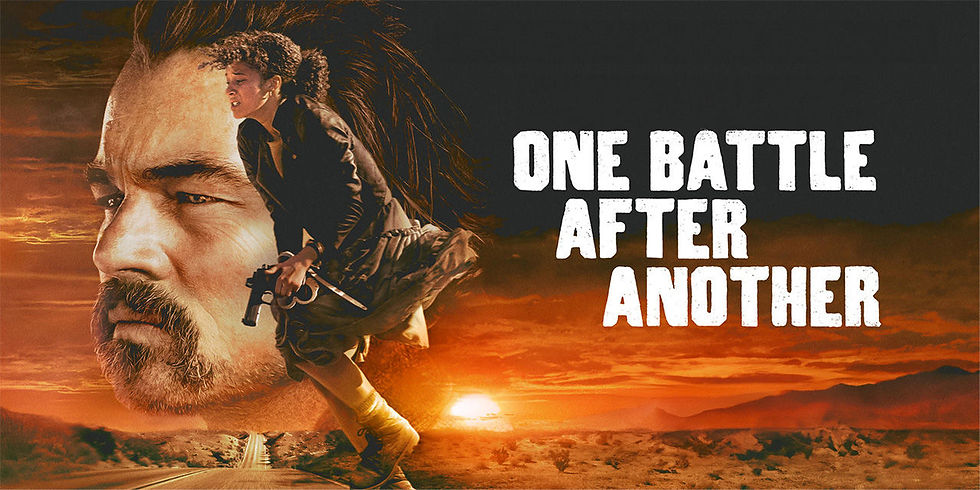
Set in a world that mirrors the present without naming it, the film drags the ghosts of past rebellions into a landscape shaped by fear, control, and institutional cruelty. The story pulses with urgency, operating on the belief that history does not end; it mutates. Yesterday’s radicalism becomes today’s inconvenience, and yesterday’s enemies return wearing sharper uniforms and friendlier slogans.
At the center is Bob, a revolutionary by association rather than design. He is rumpled, anxious, and perpetually unprepared, moving through the story with the energy of someone who knows he is already losing. His contribution to activism is minor and often accidental, yet his emotional weight is enormous. Bob embodies the aftermath of rebellion, the exhaustion, the confusion, the sense that the cause has outpaced the person.
Surrounding him are figures who seem carved from stronger material. Deandra operates with precision and authority, while Howard brings intellectual gravity and ideological memory. But the film belongs to Perfidia, a commanding presence whose intelligence and ruthlessness redefine power. She understands control not as brute force, but as performance, seduction, intimidation, and strategy folded into one. Her interactions with a grotesquely authoritarian military figure crackle with menace, turning obsession into a weapon. Few images are as arresting, or as defiant, as her unleashing gunfire while heavily pregnant, a moment that collapses motherhood, militancy, and myth into a single, unforgettable frame.
The narrative fractures time, leaving Bob stranded in a diminished future. He is now a single parent to a teenage daughter he believes is his, drifting through days soaked in alcohol, nostalgia, and unfinished ideals. His home becomes a mausoleum of lost movements, looping old revolutionary films while real life presses in. His daughter, Willa, stands in sharp contrast, disciplined, perceptive, and quietly formidable. Trained in combat and guided by focus rather than fury, she represents a new generation shaped by the consequences of choices she did not make.
As old alliances resurface, Bob is forced to confront how much of himself has eroded. Passwords are forgotten. Loyalties blur. Memory itself becomes unreliable. For Willa, the resurfacing past brings its own reckoning, unraveling truths about her mother and raising questions that destabilize everything she thought she knew about family, origin, and belonging.
Tonally, One Battle After Another thrives on contradiction. It is absurd and grave, exhilarating and opaque. The film’s momentum feels intentionally excessive, its visual language buzzing with agitation. Action sequences unfold like hallucinations, especially a hypnotic chase through rolling terrain that feels less like escape and more like recurrence, a suggestion that the struggle simply changes scenery.
Beneath the chaos lies a deeper inquiry about inheritance: who owns history, who pays for it, and who is left to clean up its wreckage. The film’s central questions, about parentage, allegiance, and identity, mirror a larger cultural dispute over who belongs and who decides.
Unfashionable in its ideas and unapologetic in its tone, One Battle After Another is a film about dissent as a lonely act. It does not offer solutions or victories. Instead, it honors persistence, the stubborn, often ridiculous determination to keep going even when clarity is gone. In a world that rewards silence and smooth edges, this film chooses noise, friction, and refusal. And that, ultimately, is its quiet form of courage.


Comments